Last Updated on June 6, 2026 by Yatrapur
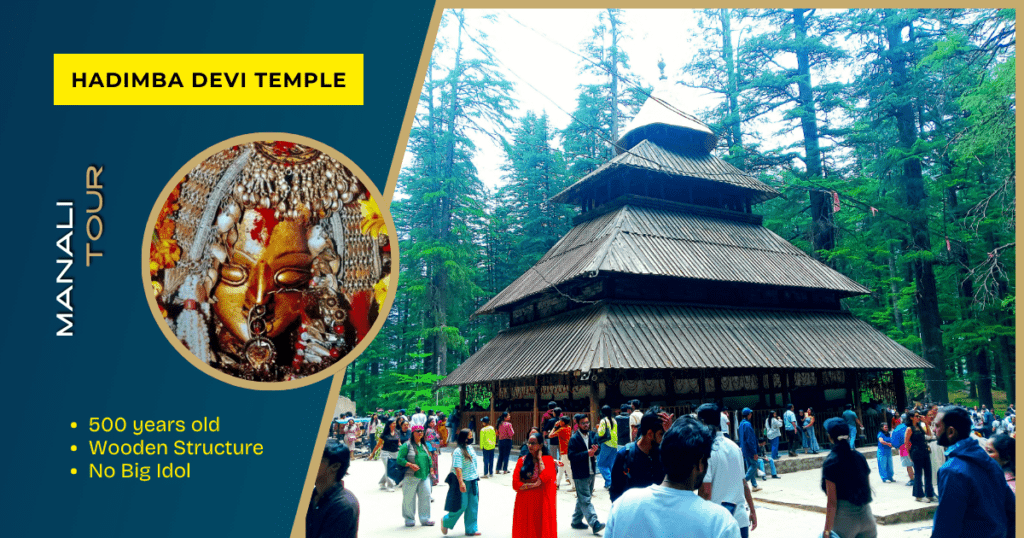
The Hadimba Devi Temple is one of the most famous landmarks in Manali, attracting countless tourists and devotees every single year. The beautiful wooden structure we see today is approximately 500 years old, built way back in 1553. Visitors love learning about the fascinating story of Hadimba Devi (also spelled Hidimba Mata), a legendary tale of a demoness who transformed into a beloved divine goddess through powerful devotion.
- Alias: Dhungari Temple (local name), a Hindu Temple
- Location: Near Mall Road, Manali (Google Map)
- District: Kullu, Himachal Pradesh
- Deity: Hidimbi (Hadimba Devi)
- Festivals: Dhungari Mela
The temple, located within the Himalayan pine forest, offers a picturesque scene. It is near Manali’s main market, Mall Road, and can be accessed by vehicle or by ascending the steps. The story of this temple begins from the Mahabharata period, which includes the battle of the second Pandava Bhima with a demon named ‘Hidimb’ [हिडिम्ब] and love for ‘Hidimba’ [हिडिम्बा].
Let’s know everything, one by one!
Table of Contents
Best time to visit
- Entry Fees: Free
- Daily Timings: 08:00 AM to 06:00 PM (Whole week)
- Best Time for Darshan: Arriving between 08:00 AM and 09:30 AM is ideal.
- Average Duration: 45 to 60 minutes
Guidelines: Avoid bringing leather products (belts or wallets), alcohol, cigarettes, or non-veg food into the temple or its grounds.
Aarti Timings
Daily Aarti, Puja & ritual timings are as follows:
| Ritual / Aarti | Timing | Description |
| Mangala Aarti | 08:00 AM | Performed as the doors open to start the day. |
| Abhishek & Puja | 09:00 AM – 11:00 AM | Holy cleaning and decorating of the sacred footprints. |
| Bhog Aarti | 12:00 PM | Mid-day prayer with food offerings. |
| Sandhya Aarti | 05:00 PM | Evening prayer with oil lamps and incense. |
| Shayan Aarti | 06:00 PM | Final daily prayer before the temple gates close. |
Special Days and Rituals
Ghor Puja: During Navratri in October
- The local priests carry out a grand ceremonial procession of the deity’s idol through the local area, accompanied by community prayers and the recitation of sacred texts.
Dhungri Mela Rituals (Mid-May)
- Local villagers from surrounding areas bring brightly decorated wooden chariots, symbolising various gods, to the temple courtyard to celebrate the goddess’s birthday. There, they gather for traditional group dances, music, and special community feasts.
Story of Hadimba Devi Temple
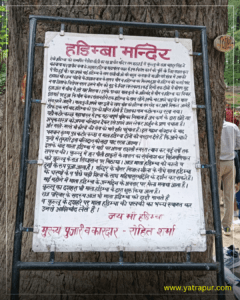
During the Mahabharata era, the five Pandava brothers lost everything in a game of dice against their 100 cousins, the Kauravas. As a punishment, the Pandavas were forced to live in exile for 13 years. During their travels, they spent some time hidden away in the forests of present-day Manali.
During that time, a demon named Hidimb and his sister Hidimba ruled the forest of Manali. Bhima, the second Pandava brother, fought a fierce battle with Hidimb and killed him. Afterward, Hidimba married Bhima with the blessings of his mother, Kunti. But there was a special condition for this marriage. Bhima could only stay with Hidimba until they had a child, and then he would have to leave. Mother Kunti left with her other four sons, leaving Bhima behind. Bhima stayed in the quiet mountains with Hidimba for a full year until their son, Ghatotkacha, was born. As agreed, Bhima then resumed his journey to join his brothers in their exile.
Once Bhima departed, Hidimba stayed back alone to raise her powerful son. She chose to leave her demon identity behind and spent many years performing intense penance in the forest. Through her deep prayers, she successfully attained the sacred status of a goddess. According to local beliefs, Mother Hadimba still guards this region today, watching over and protecting the local people.
Today, visitors can see a sacred spot dedicated to Ghatotkacha just a few steps away from the main temple.
Hadimba Devi Temple History
The gorgeous wooden temple we see today was built by Maharaja Bahadur Singh in the year 1553. Featuring unique pagoda-style architecture, the Hidimba Devi Temple stands tall at an impressive height of 24 metres.
Located in the beautiful Dhungri Van Vihar deodar forest, this ancient cave temple is dedicated to Bhima’s wife, Goddess Hidimba. The entire temple complex is built over a huge natural rock that juts out of the ground. Inside the temple, the sacred footprint of Hidimba Mata is deeply worshipped. Devotees believe that the natural imprint on this giant rock belongs to Hidimba Devi herself.
Architecture of Hadimba Devi Temple
The Beautiful Architecture & Wood Carvings
- The Amazing Gate: The main wooden door of the Hadimba Temple has very beautiful and detailed carvings. The main art shows Bhu-Devi Durga (the Earth Goddess). You can also spot tiny carvings of animals, leaves, dancers, scenes from Lord Krishna’s life, and the Navagrahas (nine planets).
- The Unique Layered Roof: Right above the holy shrine, the wooden tower rises 24 metres high. The building is made in a special “pagoda” style. The bottom three roofs are square and covered with flat wooden tiles. The fourth and top roof is a sharp cone made of shiny brass.
- The Mud and Stone Base: The bottom parts of the temple are built the old-fashioned mountain way. They use stones covered in white paint and local mud.
Secrets and Stories Inside the Temple
- The Giant Rock and Tiny Statue: Inside the temple, there is no large statue. Instead, you will see a huge natural rock that locals call “Dhung”. On top of this rock sits a tiny bronze statue of Goddess Hadimba, which is only 3 inches (7.5 cm) tall!
- The Mystery of the Hanging Rope: There is a heavy rope hanging right in front of the giant rock. According to old stories, people in ancient times would tie the hands of criminals to this rope and swing them against the rock as punishment.
- The Legend of the Cut Hand: A famous local story says that the king of Kullu was amazed by the gorgeous wooden carvings. He was afraid the artist would make another temple like this somewhere else, so he ordered the artisan’s right hand to be cut off! However, the brave artist learned to carve with his left hand and made another beautiful temple in Chamba.
- The Kullu Dussehra Rule: Goddess Hadimba is loved as the grandmother and main deity of the Kullu royal family. Even today, the famous international Kullu Dussehra festival cannot start until Goddess Hidimba’s royal chariot arrives from Manali.
- Ghatotkacha Temple: Just 70 metres away from the main building sits a small, open shrine under the tall trees. This spot is dedicated to Ghatotkacha, the brave son of Hadimba and Bhima.
- The Holy Footprints: The most peaceful part of the temple is the sacred footprints marked on the stone inside the cave. Devotees believe that praying at these footprints makes all their wishes come true.

Rules to Follow
Protected Monument by Archaeological Survey of India
This monument has been declared to be of national importance under the Ancient Monuments and Archaeological Sites and Remains Act, 1958 (24 of 1958). Whoever destroys, removes, injures, alters, defaces, imperils or misuses this monument shall be punishable with imprisonment, which may extend to three months, or with a fine, which may extend to five thousand rupees, or with both.
Further under sub-rule 32 of the Ancient Monuments and Archaeological Sites and Remains Rules, 1959, and the notification issued in 1992, areas up to 100 metres from the protected limits and further beyond it up to 200 metres near or adjoining protected monuments have been declared to be prohibited and regulated areas, respectively, for purposes of both mining operations and construction. Any repair, addition or alteration and construction/reconstruction within these areas needs prior approval of the Archaeological Survey of India.
Related Articles:
- Kullu Manali | What to See and Do in the Valley of the Gods
- Rohtang Pass at 13,058 ft: Best Time, Travel Guide & Snow Tips
- Experience Beyond Temples: Offbeat Chardham Yatra
Social Media: Instagram | x.com