
Last Updated on October 10, 2026 by Yatrapur
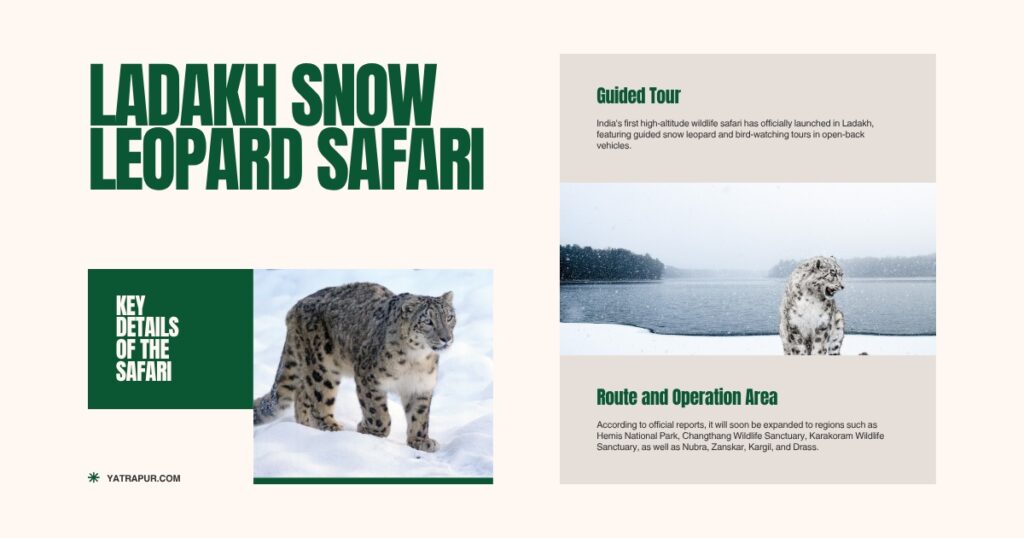
India’s first high-altitude wildlife safari has officially launched in Ladakh, featuring guided snow leopard and bird-watching tours in open-back vehicles.
On October 7, 2026, Ladakh officially launched India’s first high-altitude snow leopard wildlife safari. Lieutenant Governor of Ladakh, Vinay Kumar Saxena, flagged off six custom-designed open jeeps from Leh’s Choglamsar Protected Forest for the safari during ‘Wildlife Week 2026‘.
Following are the key and latest information related to this historic wildlife safari:
Key Details of the Safari
- Launch Date: October 7, 2026
- Launched by: Vinai Kumar Saxena (Lieutenant Governor of Ladakh)
- Operational Areas: Rumbak, Shang, and Uley
- Fleet: Six specially designed open-back vehicles operated by trained local drivers and wildlife guides.
- Organizers: Snow Leopard and High-Altitude Nature Conservation (SHAN) Society.
Route and Operation Area
In the initial phase, this safari is being conducted on selected routes where snow leopards are most commonly seen:
- Rumbak
- Shang
- Uley
According to official reports, it will soon be expanded to regions such as Hemis National Park, Changthang Wildlife Sanctuary, Karakoram Wildlife Sanctuary, as well as Nubra, Zanskar, Kargil, and Drass.
Wildlife and Biodiversity
- Snow Leopards: Ladakh holds 477 of India’s estimated 718 snow leopards.
- Other Fauna: Himalayan brown bears, wolves, kiang, and the black-necked crane.
- Flora and Avifauna: Home to over 340 bird species, 38+ mammal species, and roughly 1,800 vascular plant species.
Snow leopard population in Ladakh
According to reports, there are an estimated 718 snow leopards across India, of which 477 live in Ladakh alone. This number represents approximately 68% of India’s total snow leopard population, making Ladakh the most ideal destination in the country for this safari.
Responsible and regulated tourism
Safari vehicles strictly follow designated administrative tracks to protect Ladakh’s fragile ecosystem and prevent off-roading damage. The initiative empowers local communities by exclusively employing trained local drivers and wildlife guides.
- Strictly on fixed paths: Safari vehicles will only run on routes set by the administration to prevent damage to wildlife and the fragile Himalayan ecosystem. This will also check illegal off-roading.
- Promoting local employment: The safari is jointly operated by the Snow Leopard and High-Altitude Nature Conservation (SHAN) Society and the Forest Department. Only trained local drivers and guides are employed to provide sustainable employment to local youth.
- Bird Watching Sites: In addition to snow leopards, tourists will also have the opportunity to observe rare birds of Ladakh, Himalayan brown bears, and wolves in their natural habitats during the safari. For this purpose, youth are being specially trained in bird watching.
Best time to visit
If your goal is to spot the elusive “Ghost of the Mountain,” the absolute best months to visit Ladakh for a Snow Leopard Safari are from November to April.
While the winter is very harsh, this is the exact period when hunting animals move down into the valleys that are easy to reach.
- November to December (the Blue Sheep Rut): This is a highly underrated window. Bharal (blue sheep), the snow leopard’s primary prey, enter their mating season. Their intense activity and vocalizations make them easy to spot, and leopards follow them closely on mountain peaks.
- January to March (Deep Winter & High Activity): This is the busiest tracking window. Heavy snow covers the mountains, which forces the leopards to descend into the valleys and creates a white background that makes tracking their brown coats easier. February and March also mark the leopards’ own mating season, meaning they are much more vocal and active.
- April (Mild Cold): Extreme cold starts to decrease, making the weather somewhat more tolerable for tourists, though melting snow causes heat haze which can obstruct distant views.
Note: Since this safari is currently being launched on a limited scale, the fares, detailed booking process, and daily schedule will be officially announced soon. Before planning your trip to Ladakh, you can check the latest regulations on the official Ladakh Tourism website.


