Last Updated on May 7, 2026 by Yatrapur
Suryamal Mishran was a great poet and historian who was the court poet (Rajkavi) of Maharao Ramsingh, the ruler of Bundi state in the 19th century. His father Kaviraj Chandidaan was also the court poet of Bundi state before him. Maharao Vishnu Singh had conferred the title of Kaviraj on his father Chandidaan, but Suryamal rose even higher in his lifetime and received the title of Mahakavi.
A knower of about six languages and endowed with a blend of knowledge of diverse subjects, Suryamal Mishran devoted his entire life to the service of literature. There is no officially declared “State Poet” for Rajasthan. But, Suryamal Mishran is considered the ‘State Poet’ or ‘Rajya-Kavi’ of Rajasthan.
Suryamal Mishran : An Introduction
- Born – 19 OCtober 1815 (Harna, Bundi State)
- Died – 11 October 1868 (Bundi)
- Father – Kaviraj Chandidan
- Mother – Bhawani Bai
- Spouse – He had six wives, whose names were – ‘Dola’, ‘Suraksha’, ‘Vijaya’, ‘Yasha’, ‘Pushpa’ and ‘Govinda’.
- Occupation – Poet, Historian
- Language – Sanskrit, Hindi, Rajasthani, Dingal, Prakrit, Apabhramsa
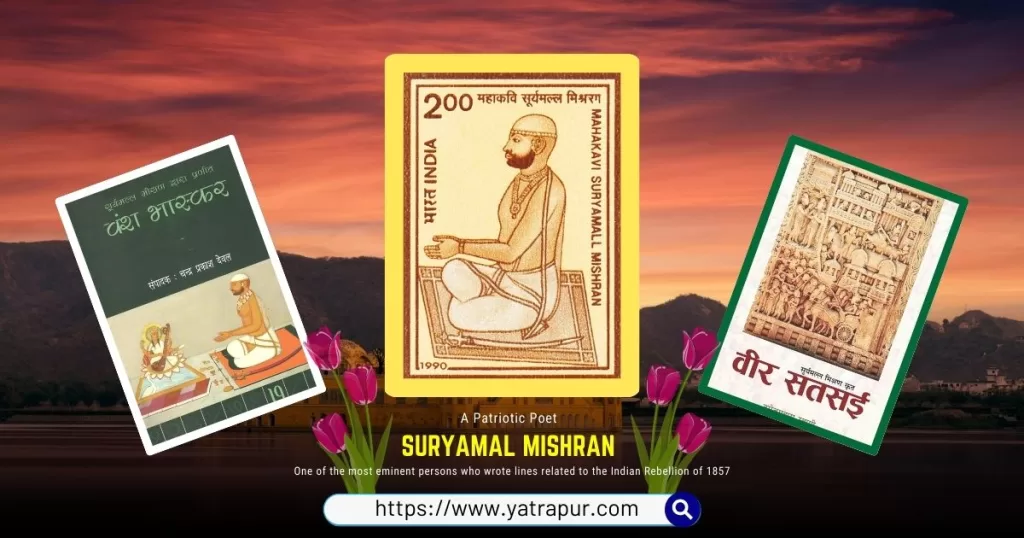
- Notable works ✍️ – Vansha Bhaskar, Veer Satsai, Sati Raso, Balwant Vilas, Chhandomayukh
Major Works
Suryamal Mishran and his works are known for heroic poetry and instilling a sense of national pride in Rajasthan. The specialty of Suryamal Mishran, a poet endowed with full splendor, was that his nature and joyful life did not have any adverse effect on his poems. Even the compositions of Shringar Rasa were restrained. The most famous works written by him are as follows –
Vansh Bhaskar
This is his most famous work. This historical epic describes the history of the Hada Chauhan rulers of the Bundi state. It is a detailed historical account which is also a repository of ancient Indian knowledge on subjects like war, religion and astronomy. Suryamal Mishran left this work incomplete after differences arose due to his patron (then Bundi Raja Ram Singh Ji) becoming the patron of the British. (Buy on Amazon)
Vir Satsai
‘Veer Satsai’ is a masterpiece of Hindi literature, composed by Suryamal Mishran, a famous 19th-century Rajasthani poet. This work is one of his great texts, which contains 288 couplets. This composition is so impressive that it is said that listening to it inspires the brave and pricks the cowards like a thorn.
This is a Veer Rasa Pradhan composition. It vividly depicts the bravery, sacrifice and martyrdom of Indian kings and heroines of the time of the First War of Independence of 1857. It is written in honor of those who opposed foreign rule and chose “honorable death instead of a life of slavery”. (Buy on Amazon)
Sati Raso
‘Sati Raso’ is a famous poetic text belonging to the Raso tradition of Rajasthani literature. This Raso poem describes the glory and valor of the Sati tradition prevalent in the Rajput society of that time. This composition not only describes a social custom, but also shows the self-respect, bravery and devotion of the Rajputs through it. It tells how after the Rajput heroes were martyred in the war, their brave women became sati to protect their honor.
‘Sati Raso’ is an important part of Rajasthani literature that helps in understanding the society, culture and values of the time, especially in the context of Rajput traditions.
Balwant Vilas
‘Balwant Vilas’ was composed as the court poet of Rao Raja Balwant Singh, the ruler of Bundi. In this book, the poet has praised the valour, bravery and rule of Balwant Singh. This book is a confluence of both Veer Ras and Shringar Ras. Its language is a mixture of Braj and Dingal.
Chhandomayukh
This book is a detailed and authentic book on prosody for Hindi and Rajasthani poetry. In this, the poet has given a detailed discussion of different types of chhands, their characteristics and examples. The main objective of ‘Chhand Mayukh’ was to give detailed information about the rules of poetry composition and chhands so that poets can use them correctly in their compositions. Its language has the influence of Braj and Dingal. This book shows Suryamal Mishran’s scholarship and deep knowledge of poetics.
Ram Ranjaat
This is a heroic composition. It has a powerful description of events related to war and bravery. This book is an important source for understanding the history of Bundi state and the circumstances of that time. Its language is a mixture of Braj and Dingal.
Death
Although Suryamal Mishran’s life was full of knowledge, respect, wealth and other resources, he was saddened by the fact that he had no children. In the last days of his life, he was always in despair. Another reason for Mishran’s sadness, a supporter of unbroken independence, was the increasing influence of British rule. Seeing his lineage not progressing and seeing the glorious families of Rajputana moving towards slavery, he kept drowning in the ocean of sorrow.
To forget his sorrow, he resorted to wine and music. But his habit of drinking alcohol kept increasing day by day. Due to this habit, his body became weak. And due to poor health, he died in Bundi on October 11, 1868 (V.S. 1925 Ashad Krishna Ekadashi). Due to his wide influence, the intellectuals of Rajasthan as well as Malwa were very sad and many poems were written on him as a tribute.
Suryamal Mishran Shikhar Award
Suryamal Mishran Shikhar Puraskar is given in the memory of the great 19th century poet-historian Suryamal Mishran for his invaluable contribution to Rajasthan literature. It is a prestigious literary honour given by Rajasthani Bhasha Sahitya Evam Sanskriti Academy, Bikaner, Government of Rajasthan. It includes a cash prize, which has varied over the years and is currently ₹71,000.
Notable Recipients: The award has been given to several distinguished writers for their works, including:
- Kanhaiya Lal Sethia for his poetry collection “Sabad” in 1987.
- Arjun Deo Charan for his drama “Dharam Juddha” in 1997-98.
- Chandra Prakash Deval for his work “Udeek Puran” in 2004-05.
- Dr. Manmohan Singh Yadav for his book “Kudrat Soon Kuchmad” in 2023-24.
Suryamal Mishran’s life story is a powerful testament to nationalism, independence, and Indian culture. He believed that a life of slavery was worse than death itself. Through his literary works, which were steeped in Indian culture and national ideals, he actively inspired nationalist sentiments among the people. As a staunch supporter of independence, he openly opposed British rule during the 1857 Revolt. Truly, his words are sharper than a sword.
Related Articles –
- Hadi Rani – Symbol of Bravery and Patriotism of Rajasthan
- Ramgarh Vishdhari Tiger Reserve: Bundi’s Wild Heart
- Kajli Teej Festival – Highlights the Culture of Bundi
- Kumbhalgarh Fort: The Great Wall of India | Tour Guide
- Jodhpur | Tourist Friendly Blue City of India
Social Media – Instagram | x.com